U.S. IPO & Equity Capital Markets Brief
 Eric Friedman
Two significant IPOs, Oura and Accelevation, are set to price this week, marking a pivotal moment in the market with substantial secondary supply and investor interest.
Coverage: Traditional U.S. operating-company IPOs and consequential ECM transactions of at least $100 million
1. Executive Summary
Two qualifying IPOs are scheduled to price Tuesday and begin trading Wednesday: Oura and Accelevation Holdings. Together they represent approximately $2.76 billion of base proceeds at midpoint and make this the most consequential new-issue day since the summer window.
The books are constructive. Oura was heard approximately 3x covered before its Boston roadshow, while Accelevation was heard 3–4x covered as of Friday. Both deals are more than 70% secondary and carry large base floats, so final price sensitivity, share-count discipline and allocation quality matter more than the headline coverage multiples.
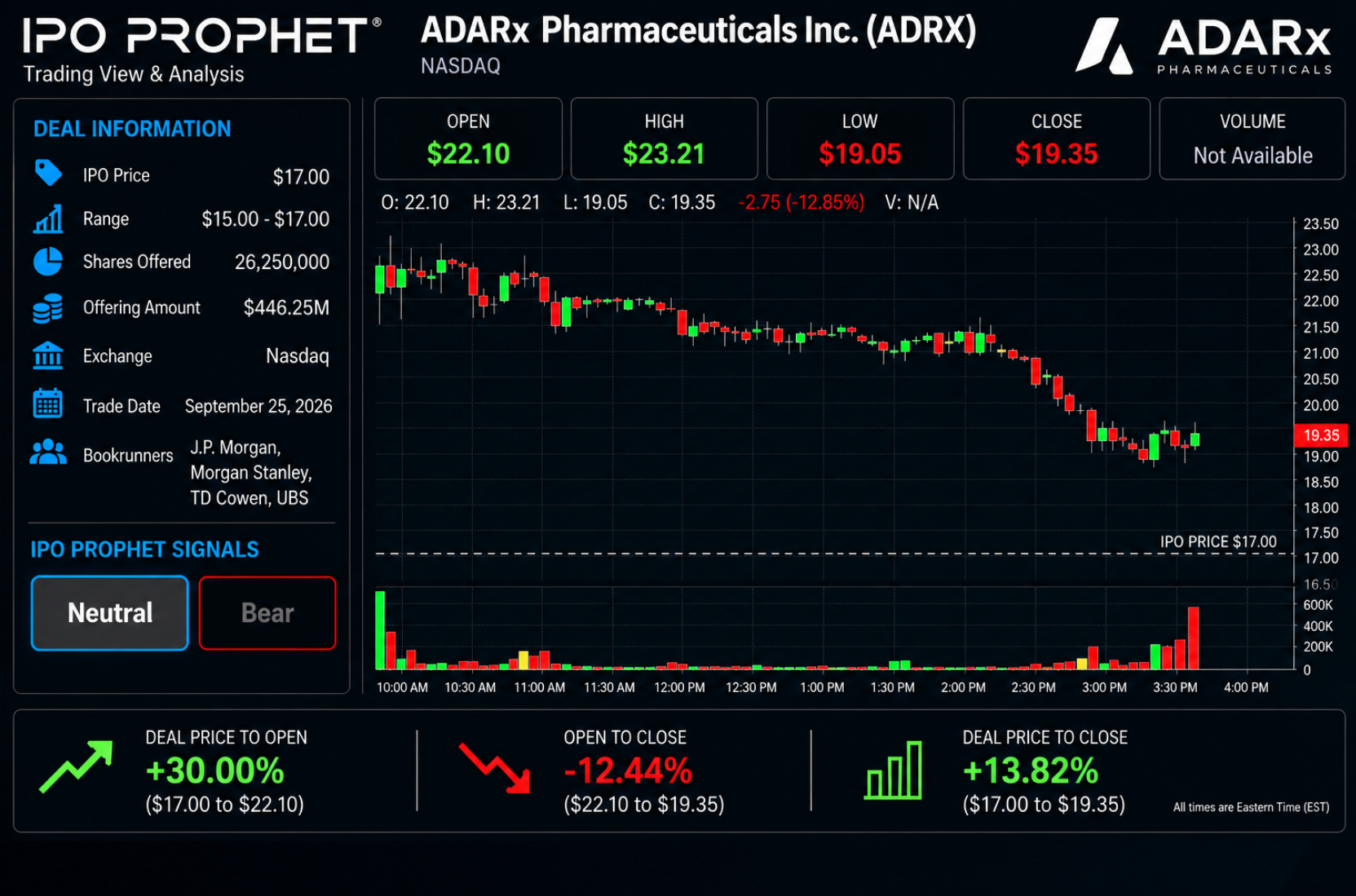
IPO Prophet® shows a 44 WARM Heat Index. ADARx’s strong financing and neutral first-day signal showed that even a well-covered book can produce a poor opening entry. Oura and Accelevation must prove demand remains after the first institutional rotation.
2. Active Qualifying IPO Calendar
| Issuer | Expected | Range | Shares / midpoint | Venue | Lead underwriters | IPO Prophet® rating |
|---|---|---|---|---|---|---|
| Accelevation Holdings (ACCV) | Price Sept. 29; trade Sept. 30 | $20–$24 | 30.0M / $660M | Nasdaq | Morgan Stanley; J.P. Morgan | 7.90 / 10 |
| Oura (OURA) | Price Sept. 29; trade Sept. 30 | $40–$44 | 50.0M / $2.10B | Nasdaq | Goldman Sachs; Morgan Stanley; J.P. Morgan; Allen & Co.; Jefferies | Not publicly displayed |
No consequential non-IPO U.S. ECM transaction of at least $100 million with a firm execution date was identified at the cutoff.
3. Deal Analysis
Oura (OURA)
Terms and execution. Oura is offering 50.0 million shares at $40–$44, implying $2.10 billion at midpoint. Oura is selling 13.5 million shares and existing holders 36.5 million, making the base deal 73% secondary. Goldman Sachs, Morgan Stanley, J.P. Morgan, Allen & Co. and Jefferies are joint lead bookrunners. Nasdaq trading is expected September 30.
Demand and book strength. The book was heard approximately 3x covered before the Boston roadshow. Eli Lilly has indicated interest in up to $100 million and Dragoneer in up to $300 million, roughly 19% of midpoint proceeds. The 50 million-share base means the deal is not scarce on share count alone.
Float, FOMO and price discovery. Oura has the strongest brand recognition and clearest FOMO potential. The best setup is an intact deal priced at the top or above range, a controlled opening premium and a first pullback that holds well above issue. A large premium open could capitalize the scarcity narrative before trading begins.
Key risks. The offering is seller-heavy, and most expected primary net proceeds are earmarked for tax obligations associated with employee equity awards. Valuation, hardware competition, consumer cyclicality, privacy concerns and subscription-growth durability are the main risks.
Accelevation Holdings (ACCV)
Terms and execution. Accelevation is offering 30.0 million shares at $20–$24, implying $660 million at midpoint. The company is offering 8.64 million shares and selling holders 21.36 million, making the base deal 71% secondary. Morgan Stanley and J.P. Morgan are joint lead bookrunners; Goldman Sachs, Barclays and BofA Securities are also joint bookrunners. Nasdaq trading is expected September 30. IPO Prophet® rates the deal 7.90 out of 10.
Demand and book strength. The book was heard 3–4x covered as of Friday. Revenue reached approximately $437.5 million in the first half of 2026, net income was approximately $18.8 million and backlog was about $1.1 billion at June 30. Those figures support the AI-infrastructure growth case, but coverage must be tested against price sensitivity because most shares are sponsor supply.
Float, scarcity and price discovery. Thirty million shares is meaningful supply, and the 4.5 million-share option is entirely secondary. The deal can still trade well if allocations concentrate with long-only investors seeking picks-and-shovels AI exposure, but it is not a low-float squeeze. A top-half price, intact shares and a stable opening auction would be more bullish than a large, fast premium that immediately fades.
Key risks. Customer concentration, data-center capital-spending cyclicality, execution against backlog, leverage and sponsor monetization are the main constraints. The Up-C structure and debt-repayment use of primary proceeds also make valuation discipline important.
4. Underwriter and Market Structure Read-Through
Morgan Stanley and J.P. Morgan lead both transactions, while Goldman Sachs sits prominently on each syndicate. That concentration gives the banks a direct allocation and price-discovery challenge across $2.76 billion of midpoint supply on the same trading day.
Both deals combine strong demand narratives with heavy secondary supply. Oura offers brand and subscription momentum; Accelevation offers AI-infrastructure growth and backlog. In each case, the sellers are testing how much thematic demand can absorb without an issuer-friendly concession.
The window will be healthier if both deals price with intact share counts and hold above issue through the close. A strong open followed by a low close would repeat the ADARx lesson: good financing execution does not guarantee a good issuance-day trade.
5. IPO Prophet® Read-Through
For Oura, the 3x coverage indication and $400 million of cornerstone interest support the book, but the 50 million-share float and 73% secondary mix cap pure scarcity. A Bull signal should require evidence that opening demand exceeds the supply already reflected in a potentially aggressive first print.
For Accelevation, the 7.90 rating and 3–4x coverage indicate a constructive setup, but the 71% secondary mix raises the bar for allocation quality. The AI theme can create momentum, yet a durable move needs intact terms, limited price sensitivity and a first pullback that holds.
Across both deals, the framework remains unchanged: measure tradable float against institutional demand, distinguish FOMO from durable sponsorship, and do not treat an opening premium as bullish unless the post-open tape confirms it.