U.S. IPO Recap Week of 10/30/2026
 Eric Friedman
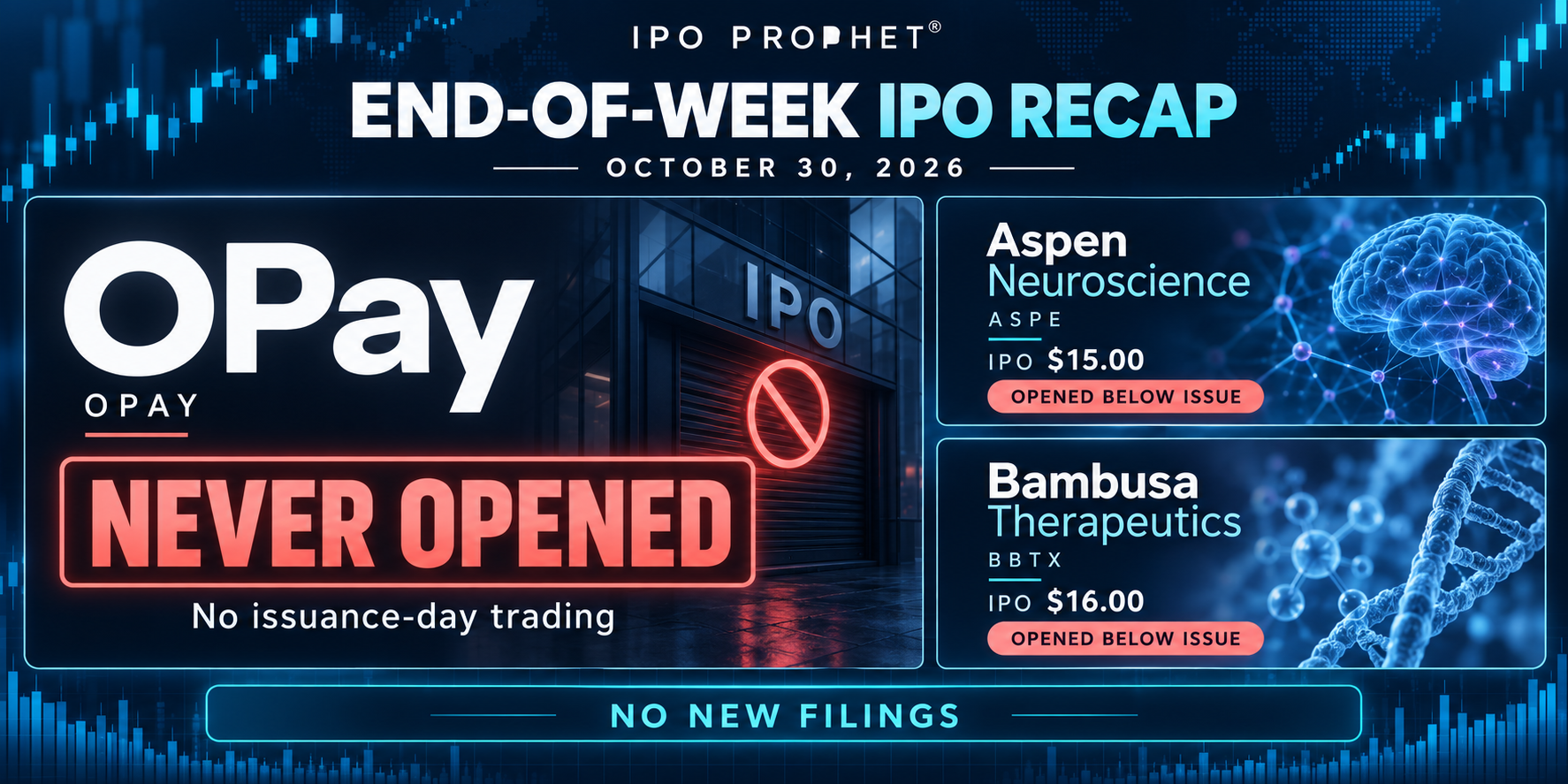
This week's IPO recap highlights OPay's rescinded offering, with Aspen Neuroscience and Bambusa Therapeutics experiencing disappointing debuts.
Period: Week ended October 30, 2026
Coverage: Traditional U.S. operating-company IPOs of at least $100 million; consequential ECM and verified Q4 pipeline developments
OPay Fails to Open as Desk Reports Point to IPO Rescission
OPay is the defining execution development of the week. According to IPO Prophet® desk information, the shares never opened for trading on October 30, and the entire offering was reportedly rescinded. This is an offering-status event, not a missing market-data issue. Formal rescission confirmation and the reason for the failed opening remain outstanding; earlier issuer publicity announcing trading does not resolve that discrepancy.
The two IPOs that actually debuted were Aspen Neuroscience and Bambusa Therapeutics, representing approximately $309.5 million of base offering proceeds. Both opened below issue and closed down about 7%. OPay had announced pricing of 16.0 million ADSs at $19 for $304 million, but that amount is excluded from completed-offering totals pending clarification.
A relevant historical comparison is BATS Global Markets on March 23, 2012. A technical failure on its own exchange disrupted the attempted debut; the original IPO print and individual executions were cancelled, and BATS withdrew the offering. Dave Berlin recalls BATS as the only comparable incident in his 33 years in ECM. That is a firsthand career observation, not a claim that an exhaustive review establishes only two such events in 35 years. No evidence currently establishes that OPay involved the same technical cause.
IPO Prophet® read-through: pricing, allocations and launch publicity are not the same as an executable public-market opening or a completed capital raise. OPay highlights opening and settlement risk; the two biotech debuts separately show that an upsize and credible deal quality do not guarantee incremental aftermarket demand.
Weekly Scorecard
| Issuer | Ticker | Final / Range | Shares / Offer | Execution | Open | High / Low | Close / Return | IPO Prophet® |
|---|---|---|---|---|---|---|---|---|
| OPay | OPAY | $19 announced / $19–$21 | 16.0M ADS / $304.0M announced | Did not open; rescission reported* | Did not open* | N/A | N/A | 7.90 pre-offer |
| Aspen Neuroscience | ASPE | $15 / $15–$17 | 9.375M / $140.6M | No size change; low end | $14.55 | $14.55 / $11.74 | $13.93 / −7.1% | 7.56 |
| Bambusa Therapeutics | BBTX | $16 / $15–$17 | 10.556M / $168.9M | +12.6% shares; midpoint | $15.00 | $15.45 / $13.75 | $14.88 / −7.0% | 7.73 |
* OPay did not open, according to IPO Prophet® desk information supplied October 30. Rescission is reported but has not been independently confirmed by an issuer, exchange or syndicate notice. The announced $304 million is not counted as completed proceeds.
Deal-by-Deal Analysis
OPay announced pricing but no trading debut
Announced terms. OPay announced 16.0 million ADSs at $19, the low end of its $19–$21 range, with no base-size change and $304 million of proposed gross proceeds. Each ADS represents ten ordinary shares. The proposed NYSE transaction included a 2.4 million ADS option. The final pricing release named Citigroup, Deutsche Bank and Standard Bank as joint bookrunners, with B. Riley and Needham as co-managers; earlier marketing materials also included CICC.
Status correction. IPO Prophet® desk information indicates OPay never opened, with reports that the entire IPO was rescinded. The prior recap incorrectly treated it as a completed debut with unavailable trading data. OPay is now classified as announced priced but not opened, with rescission reported and formal confirmation pending. There is no valid opening price, first-day return or aftermarket record to analyze. The cause, allocation treatment and any return of funds should not be inferred without a formal notice.
Demand and float. Previously disclosed non-binding investor interest and strategic private-placement support did not establish an executable opening. Without an opening, the proposed float never produced observable public price discovery. IPO Prophet®’s 7.90 pre-offering rating remains a pre-deal assessment, not evidence of execution success. The lesson is to separate book indications, pricing, opening and settlement; no opening means no realized day-one liquidity or demonstrated scarcity premium.
Aspen Neuroscience (ASPE)
Execution. Aspen sold 9.375 million shares at $15, the low end of its $15–$17 range, raising $140.6 million with no base-size change. It listed on Nasdaq. Leerink Partners, Piper Sandler, Stifel, UBS and Oppenheimer led the transaction.
First-day price discovery. ASPE opened at $14.55, 3.0% below issue, never traded above the opening print, fell to $11.74 and closed at $13.93, down 7.1%. Volume was approximately 1.13 million shares, only about 12% of the base deal size. The close recovered from the low but did not reclaim the issue price.
Demand, scarcity and lesson. Pricing at the low end and unchanged size indicated a price-sensitive specialist book rather than excess demand. The 9.375 million-share offering represented roughly one-third of post-offering shares, so the deal was not structurally scarce. IPO Prophet® rated Aspen 7.56. The opening discount and failure to print above issue show that clinical quality and a moderate absolute float could not generate FOMO in a crowded biotechnology tape. For the strategy, low-end pricing plus a below-issue open should override any scarcity thesis until the issue price is reclaimed with volume. No multi-day aftermarket history was available.
Bambusa Therapeutics (BBTX)
Execution. Bambusa sold 10.556 million shares at $16, the midpoint of its $15–$17 range, raising $168.9 million. The share count increased from 9.375 million, a 12.6% upsize. It listed on Nasdaq. BofA Securities, Evercore ISI, UBS and Cantor led the transaction.
First-day price discovery. BBTX opened at $15.00, 6.3% below issue, reached a $15.45 high, fell to $13.75 and closed at $14.88, down 7.0%. Volume was approximately 2.20 million shares, about 21% of the enlarged base deal. The stock spent the entire session below issue.
Demand, scarcity and lesson. The upsize and midpoint pricing were the week’s strongest primary-book signals, but the extra supply expanded tradable float just as Bambusa competed with Aspen for specialist capital. IPO Prophet® rated Bambusa 7.73. The result separates book completion from aftermarket sponsorship: a book can absorb more shares and still lack the incremental buyers needed for a premium open. For the strategy, an upsize is bullish only when allocation quality and opening demand are strong enough to absorb the added float. No multi-day aftermarket history was available.
Underwriter, Market-Structure and Window Read-Through
Syndicate read-through. UBS participated in both biotechnology deals. Bambusa increased supply at midpoint, but both biotech books produced below-issue openings. OPay’s announced pricing did not translate into an opening, according to desk information. Until the syndicate or exchange explains the outcome, it is inappropriate to attribute it to a technology problem, insufficient demand or another specific cause.
Health of the window. Two qualifying deals reached trading, with approximately $309.5 million of base offering proceeds, and both broke issue immediately. OPay’s reported rescission after announced pricing makes execution reliability—not just valuation—the week’s most important caution. It does not by itself establish a marketwide operational problem. The window remains selective and fragile, with the two biotech tapes providing a separate warning about aftermarket sponsorship.
Future-deal lessons. First, price placement remains the cleanest public demand signal: low-end pricing deserves caution even when anchors are visible. Second, tradable float must be judged as both a percentage and an absolute dollar amount; neither Aspen nor Bambusa was scarce enough to overcome selling pressure. Third, an upsize can weaken day-one scarcity. Fourth, the opening print is actionable information: a below-issue open with no reclaim argues for patience, not FOMO. Finally, Anthropic’s public filing becomes the next major test of whether the market can support a tightly constructed, very large technology offering without sacrificing aftermarket stability.
Q4 ECM Watchlist
All completed IPOs are removed. Each public filer below is identified as public; confidential submissions and unfiled candidates are separated explicitly. SPACs, direct listings, reverse mergers, shell-company uplistings and sub-$100 million offerings are excluded.