U.S. IPO & Equity Capital Markets Recap 10/2/2026
 Eric Friedman
Accelevation's IPO reveals market sensitivity, while Oura's postponement highlights a cautious environment. Insights on IPO dynamics and future trends are analyzed.
Coverage: Traditional U.S. operating-company IPOs of at least $100 million
1. Executive Summary
One qualifying IPO priced and began trading this week. Accelevation raised $540 million after pricing at $18, below its $20–$24 range. The shares opened at $17.55 and closed the first day at $17.95, then fell to $16.59 on the second day before recovering to approximately $17.72 on Friday.
The result was a clear price-sensitivity test. A book heard 3–4x covered did not support the proposed range, and the unchanged 30 million-share deal remained two-thirds secondary. Oura’s decision to postpone a $2.1 billion midpoint offering despite reported strong demand reinforced that the window is open only for transactions that give investors sufficient valuation and supply discipline.
2. Weekly Scorecard
| Issuer | Price vs. range | Shares / offer | Open | High / low | Close / day 1 | Oct. 2 close |
|---|---|---|---|---|---|---|
| Accelevation (ACCV) | $18 vs. $20–$24 | 30.0M / $540M | $17.55 | $18.10 / $17.52 | $17.95 / -0.3% | $17.72 / -1.6% |
3. Accelevation Holdings (ACCV)
Final terms and execution. Accelevation priced 30.0 million shares at $18.00, 10% below the bottom and 18.2% below the $22 midpoint of its $20–$24 range. Gross proceeds were $540 million, $120 million below the marketed midpoint. The total share count was unchanged, but the final mix shifted to 10.0 million primary shares and 20.0 million secondary shares from the preliminary 8.64 million / 21.36 million mix. The company therefore received more primary capital while Olympus-affiliated sellers still supplied two-thirds of the base deal.
Exchange and syndicate. The shares began trading September 30 on the Nasdaq Global Select Market. Morgan Stanley and J.P. Morgan were joint lead bookrunners; Goldman Sachs, Barclays and BofA Securities were joint bookrunners, with Houlihan Lokey, Baird, William Blair, Piper Sandler and Wolfe | Nomura Alliance also in the syndicate.
Demand and book strength. The book was heard 3–4x covered late in the roadshow, but the below-range price shows that coverage was valuation-sensitive rather than price-insensitive institutional demand. Keeping the full 30 million-share base preserved deal size at the cost of a significant price concession. The result is more informative than the headline coverage multiple: investors would participate, but not at the proposed valuation.
Issuance-day dynamics. ACCV opened at $17.55, 2.5% below issue. It traded between $17.52 and $18.10 and closed at $17.95, down 0.3% from the IPO price, on approximately 10.4 million shares. The opening auction immediately rejected the notion that the issue was scarce. Stabilization and buying near the issue price helped the shares recover, but the stock never established a durable premium.
Aftermarket performance. The shares fell to approximately $16.59 on October 1, 7.8% below issue. On Friday they traded as low as $15.03 before recovering to approximately $17.72, about 1.6% below issue. The rebound reduced the damage but did not change the central message: demand became more tactical once the underwriting support and initial allocation cycle passed.
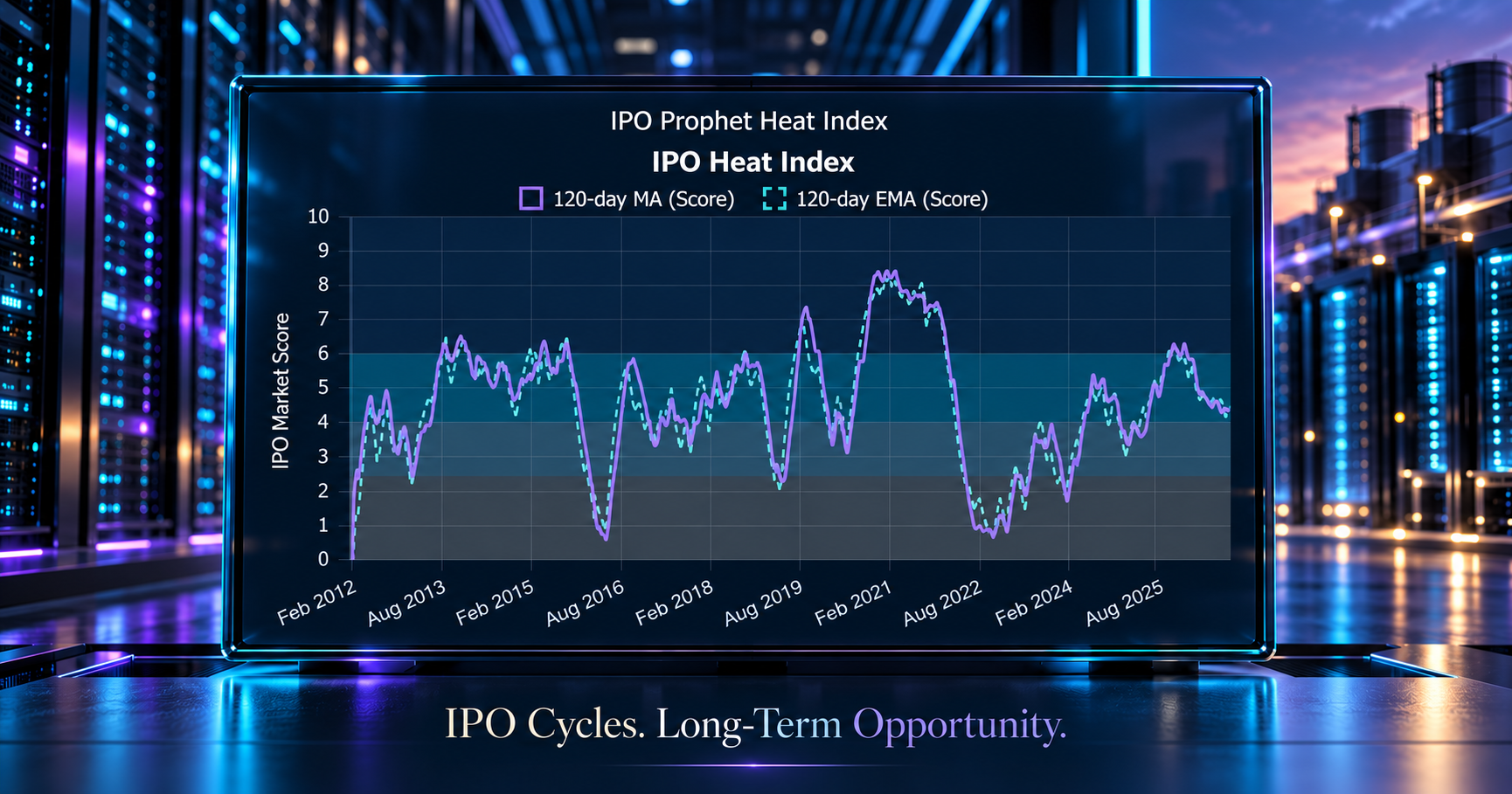
Float, scarcity and IPO Prophet® read-through. Thirty million base shares, a 4.5 million-share secondary option and a seller-heavy mix created ample tradable supply. The AI-infrastructure theme generated attention but did not overcome valuation, customer-concentration and sponsor-monetization concerns. For IPO Prophet®, the most useful signals were the below-range price and sub-issue opening print. Those execution facts outweighed the earlier 7.90 rating and reported book coverage.
4. Oura Postponement and Window Health
Oura postponed its planned 50.0 million-share offering on September 29. The deal had been marketed at $40–$44, or $2.10 billion at midpoint, with approximately 73% secondary supply. The company cited IPO-market uncertainty despite strong demand. The postponement is not a failed pricing, so Oura is excluded from the scorecard, but it is the week’s most important market-structure event.
The combination of Oura’s withdrawal and Accelevation’s below-range pricing shows a selective and fragile IPO window. Brand recognition, growth and book coverage are not enough when seller supply is heavy and public-market valuation tolerance is falling. Issuers can still complete offerings, but the clearing price must reflect the real tradable float and the quality—not merely the quantity—of institutional demand.
5. Underwriter and ECM Read-Through
Morgan Stanley and J.P. Morgan successfully completed Accelevation at the full base share count, but the $18 price transferred meaningful economics to investors. That was the correct execution choice once demand would not support the range. The more important question is whether lead banks now reset seller expectations across the postponed calendar rather than attempting to defend stale valuation targets.
The week argues for smaller floats, more primary capital, lighter selling-holder participation and wider valuation cushions on re-launches. A covered book should be treated as preliminary evidence; final price, allocation quality, opening imbalance and post-stabilization trading remain the decisive indicators.
6. Q3 Close and Q4 ECM Watchlist
The watchlist below includes qualifying traditional operating-company candidates with verified public registration statements. Accelevation is removed because it completed its IPO. Oura remains publicly filed but postponed; it is not described as an unfiled pipeline name.