U.S. IPO Recap Week of 10/9/2026
 Eric Friedman
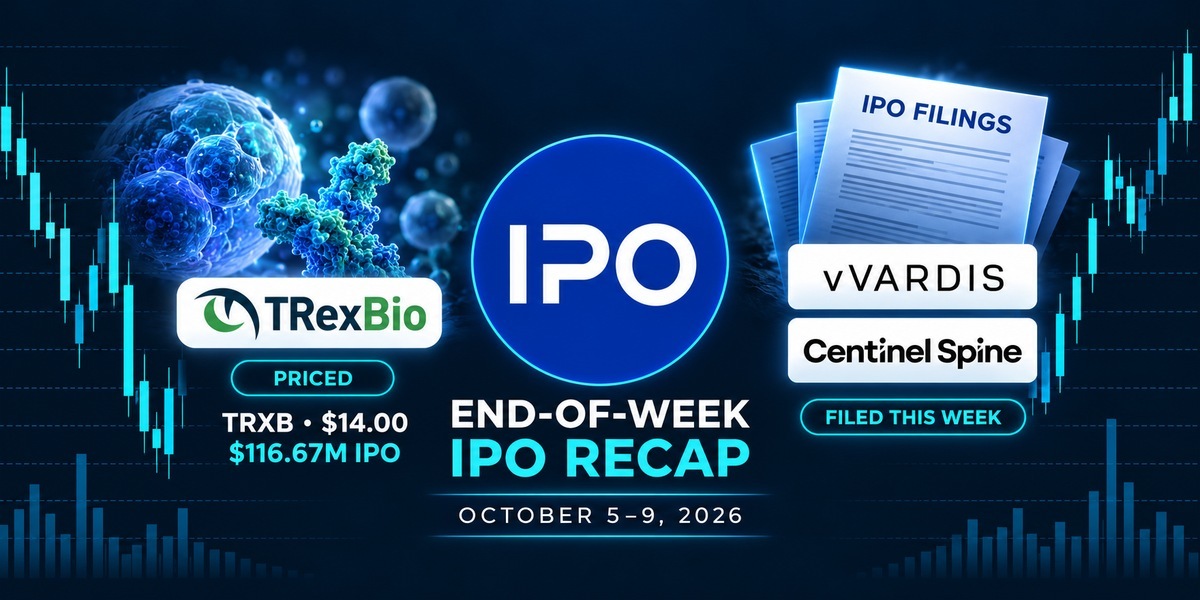
This week's IPO recap highlights TRex Bio's debut, revealing market sensitivity and a selective IPO environment for biotech amid cautious investor sentiment.
Coverage: Traditional U.S. operating-company IPOs of at least $100 million
1. Executive Summary
One qualifying IPO priced and began trading this week: TRex Bio raised $116.7 million. It priced at the low end of its range, opened below issue, recovered to a double-digit intraday premium and closed exactly at the $14.00 issue price. The result kept the financing window open for biotech, but it did not demonstrate broad risk appetite.
IPO Prophet® finished the week with a 42 WARM Heat Index. TRXB showed why the opening print must be evaluated separately from the book: the intact share count and Eli Lilly participation provided support, but low-end pricing and a below-issue open revealed price sensitivity. The intraday recovery was constructive, yet the flat close indicates limited durable scarcity.
2. Weekly Scorecard
| Issuer | Final vs. range | Shares / offer | Open | High | Low | Close | Day-one return |
|---|---|---|---|---|---|---|---|
| TRex Bio (TRXB) | $14.00 vs. $14-$16 | 8.33M / $116.7M | $13.50 | $15.50 | $13.50 | $14.00 | 0.0% |
3. Deal Analysis
TRex Bio (TRXB)
Terms and execution. TRex Bio sold 8,333,334 primary shares at $14.00, the bottom of its $14-$16 range, raising approximately $116.7 million. The base share count was unchanged, so execution involved a price concession rather than a downsizing. The underwriters have a 1.25 million-share option. J.P. Morgan, Evercore ISI, Cantor, Stifel and Wedbush were the bookrunners. The shares trade on the Nasdaq Global Select Market.
Institutional demand and book strength. Pricing at the low end signals a price-sensitive institutional book. Eli Lilly, an existing investor and strategic partner, indicated for approximately $12 million, about 10% of the base deal. That support improved deal credibility, but the $13.50 open, 3.6% below issue, showed that the allocation book did not create immediate excess demand.
Float, scarcity and issuance-day dynamics. The 8.33 million-share base was modest, but the effective scarcity was weaker than the headline float suggested. Trading volume was approximately 1.20 million shares, only about 14% of the base deal. The stock opened at its first-day low of $13.50, rallied to $15.50, and then surrendered the premium to close at $14.00.
Aftermarket performance. The close was flat to issue and 9.7% below the intraday high. The tape demonstrated two-way demand rather than sustained FOMO: buyers defended the issue area, but the market did not retain the high. The result is neither a failed financing nor a strong scarcity outcome.
IPO Prophet® and strategy lesson. TRXB reinforces that low-end pricing plus an intact share count can create enough room for an intraday recovery, but the opening discount is a warning about allocation quality and price sensitivity. For IPO Prophet®, the strongest signal was the recovery from the low; the limiting signal was the inability to hold above issue into the close. A small biotech float should not be treated as scarce unless post-open turnover and sponsorship confirm it.
4. Underwriter and ECM Trends
J.P. Morgan and specialist healthcare banks successfully completed a qualifying biotech financing while larger consumer, energy and infrastructure issuers remained sidelined or postponed. The contrast shows that capital is available for targeted clinical stories at disciplined valuations, but not yet for every large thematic deal.
The week also produced terms for Iambic Therapeutics and City Therapeutics, both expected next week. Their execution will test whether biotech demand can broaden beyond strategic-anchor support and whether investors will reward earlier-stage platforms after TRXB closed flat.
5. Health of the IPO Window
The IPO window is selective rather than closed. TRXB raised its intended base amount, but it needed low-end pricing and generated no first-day return. That is a workable financing environment, not a strong issuer market. The healthiest next step would be top-half pricing, intact shares and a close that preserves a meaningful portion of the opening premium.
6. Q4 ECM Watchlist
Each issuer below has a current public S-1 or F-1. Completed IPOs, sub-$100 million offerings, SPACs, direct listings, reverse mergers and shell-company uplistings are excluded. Postponed qualifying issuers remain listed because their registrations remain active and a Q4 re-launch is possible.
| Issuer | Verified filing status | Terms / venue | IPO Prophet® focus |
|---|---|---|---|
| Iambic Therapeutics (IAM) | Public S-1; terms set Oct. 8 | $15-$17; 9.38M; $150M midpoint; Nasdaq; Oct. 15 | AI-biotech narrative, $60M indicated interest, clinical risk and float |
| City Therapeutics (CTY) | Public S-1; terms set Oct. 9 | $17-$19; 9.72M; $175M midpoint; Nasdaq; Oct. 16 | RNAi platform, crossover sponsorship, clinical risk and scarcity |
| Oura (OURA) | Public S-1; postponed Sept. 29 | Formerly $40-$44; 50.0M; Nasdaq | Re-launch timing, 73% secondary supply, valuation and retained demand |
| Aggreko (AGKO) | Public F-1; amended Sept. 17 | Terms pending; NYSE | Power-demand theme, leverage, valuation and supply mix |
| Bamboo Insurance (BMB) | Public S-1; postponed Sept. 22 | Formerly $18-$20; 35.0M; NYSE | Re-launch timing, seller supply, catastrophe exposure and valuation |
| Centinel Spine (CNTL) | Public S-1 filed Oct. 7 | Terms pending; Nasdaq | Medical-device growth, sponsor supply, valuation and float |
| CoVolt Power (KVLT) |