Lycia Therapeutics (LYCA) Eyes $250 Million IPO to Advance Protein-Degrading Medicines
 Eric Friedman
Early allergy data supports its novel approach, but an $886 million proposed valuation puts the focus on translating IgE reductions into meaningful patient benefits.
Lycia Therapeutics (LYCA) is preparing to offer 14.7 million shares at $16–$18 per share, targeting $249.9 million in gross proceeds at the $17 midpoint and an implied post-offering market capitalization of approximately $885.6 million. The company has applied to list on the Nasdaq Global Select Market, with Jefferies, TD Cowen, Evercore ISI and Guggenheim Securities serving as joint book-running managers. Estimated midpoint net proceeds are $227.8 million, excluding the underwriters’ option.
Lycia is developing medicines designed to eliminate disease-causing proteins outside cells. Its LYTAC platform, based on work by Nobel laureate Carolyn Bertozzi, connects a target protein to a receptor that carries it into the cell’s lysosome—the machinery responsible for breaking down cellular material. The approach seeks to expand the reach of protein degradation into targets that conventional drugs may struggle to address. For investors, the appeal is the possibility of building multiple medicines from a common discovery platform, although success in one application would not establish that every program will work.
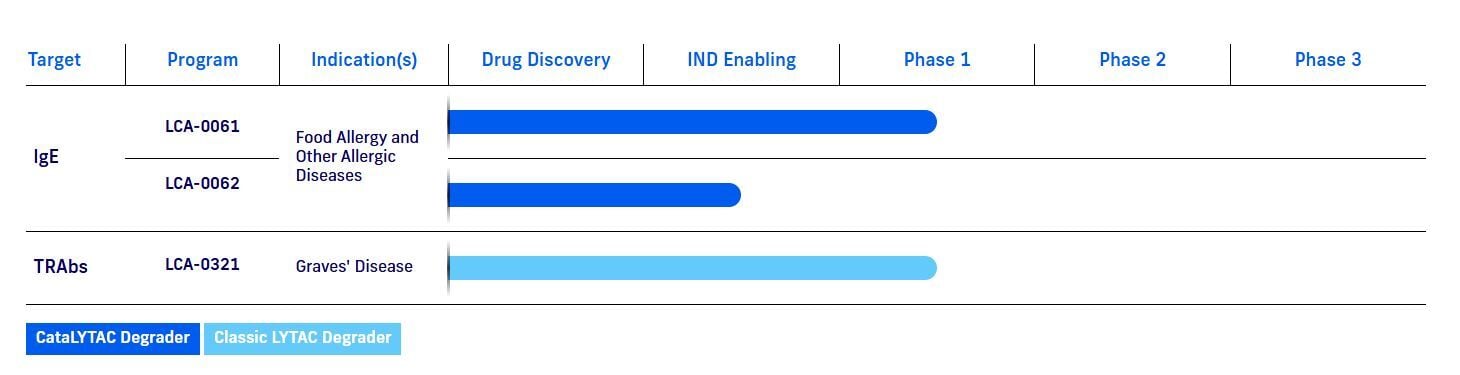
The company also distinguishes between two types of degraders. Its classic LYTAC molecules are broken down alongside the targeted protein, while its catalytic cataLYTAC molecules are engineered to return to the cell surface and repeat the process. That recycling mechanism could allow a single drug molecule to remove multiple copies of a disease-driving protein. The commercial question is whether this translates into sufficiently durable effects to improve treatment outcomes or reduce the burden of repeated dosing.
Food allergy is Lycia’s initial focus. Lead candidate LCA-0061 targets immunoglobulin E, or IgE, an antibody involved in allergic responses. The company is studying the treatment in Phase 1 participants with elevated IgE, including people with food allergy. Its second IgE candidate, LCA-0062, uses a bispecific antibody design and remains in studies needed to support clinical entry. Advancing two approaches gives Lycia opportunities to evaluate differences in dosing and duration, but it also creates an important development decision: which candidate ultimately offers the strongest profile for patients and the most efficient path forward.
The early human findings provide a reason to follow the story. Lycia reported a mean maximum IgE reduction of 96% in its initial LCA-00